
This greenhouse replaced an earlier, much more Victorian conservatory at a different spot on the grounds. The conservatory is available for events, but it is also used to keep the tropical plants that decorate the grounds in the summer.
Comments
This greenhouse replaced an earlier, much more Victorian conservatory at a different spot on the grounds. The conservatory is available for events, but it is also used to keep the tropical plants that decorate the grounds in the summer.

This house, built in about 1902, seems to have begun as a single-family house, but was split into a double fairly early in its history. Recently it was converted back to a single-family house. Newer siding has obscured some of the details, but the late-Victorian massing still comes through.

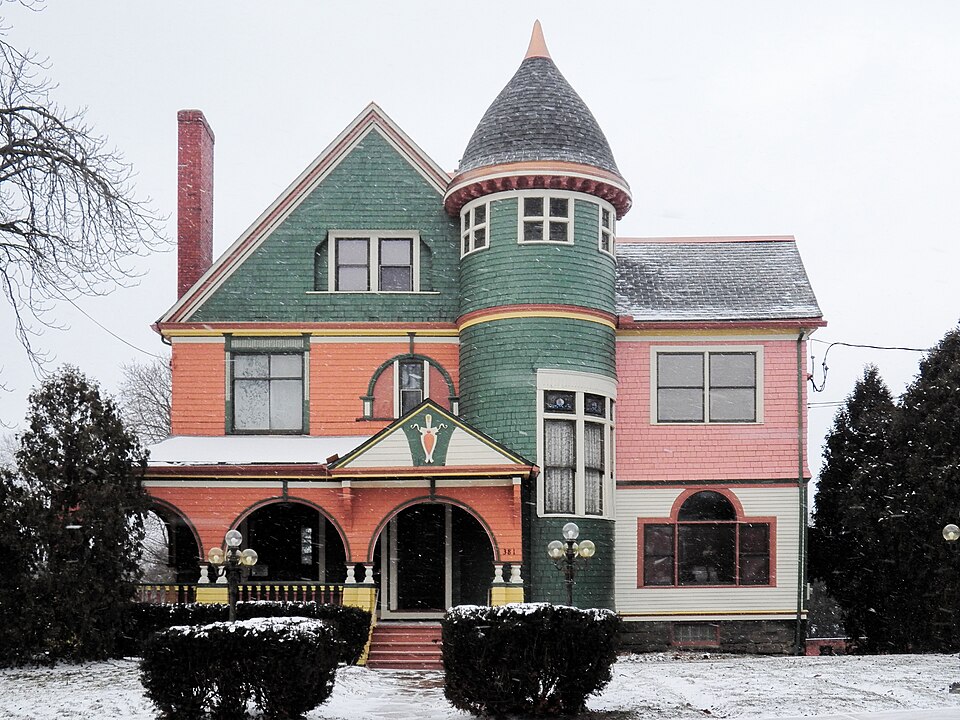
A very shingly house designed by Charles H. Owsley, who would also design the Buhl mansion across the street; this one was built in about 1890. The restoration of the house was done on a budget that did not permit custom windows to fit in the arches, but much of the most characteristic detail has been preserved.



A Georgian house on East State Street, nestled among the millionaires’ mansions of a generation earlier. This one was probably built in the 1920s or 1930s, when the Colonial Revival was taking on a more historically accurate form: it would look at home in Annapolis or Williamsburg.

Elizabeth E. Haywood was a rich widow who hired Owsley & Boucherle to design this comfortable mansion for her, which was built in 1901. When she died in 1924, she left the house to be a home for retired Presbyterian ministers and their wives—an important charity in the days when ministers usually lived in manses provided by their churches, and had nowhere to go when they retired. The parts that were originally wood have been covered with cheap materials, but the general form of the house is still intact.